
Fate Criminal History Checks
Begin a Fate search with the record’s source. Fate Department of Public Safety keeps its own incident and arrest reports. Fate Municipal Court of Record keeps city citations, Class C and ordinance proceedings, municipal warrants, docket actions, and judgments. The Rockwall County jail creates a different booking record when a custodial arrest from Fate is accepted there. County clerks keep higher filed charges.
A person’s name alone cannot show which Fate channel holds the useful document. Use the Fate citation, offense date, agency, and place of occurrence when available.
- Ask Fate Department of Public Safety for a police-created incident or arrest report.
- Send a written judicial-record request to Fate Municipal Court for a citation, city case, judgment, or municipal warrant file.
- Check Rockwall County active custody when the arrest and booking occurred in that county.
- Search the Rockwall County clerks for Class A or B misdemeanors and felonies after prosecutors file charges.
- Use Texas DPS for qualifying statewide public conviction or deferred-adjudication data, or its fingerprint process to review your own fuller Texas record.
Two Fate Records Addresses
Fate research shows two official addresses, and they serve different context. Rockwall County’s expunction directory lists the Fate Department of Public Safety records contact at 104 E. Fate Main Place, Suite B, Fate, Texas 75087, with fatepolice@fatetx.gov. The newer Fate judicial request form directs court records to 1900 CD Boren Parkway, Fate, Texas 75087.
Do not assume that the court campus is also the correct walk-in counter for every Fate police report. Confirm the receiving location with Fate Department of Public Safety before visiting. A mailed municipal court request, by contrast, should follow the address printed on the current judicial form.
Fate Public Safety Records
104 E. Fate Main Place, Suite B
Fate, TX 75087
Verify the current police-record counter before visiting.
Fate Municipal Court
1900 CD Boren Parkway
Fate, TX 75087
972-771-4601
Records at the Fate Police Department
Fate uses a Department of Public Safety structure for its city public-safety functions. When Fate personnel create an offense or arrest report, the report stays with the city department. It may contain the event location, reported facts, alleged offense, officer action, and a report identifier. It is distinct from the jail intake file and from any later court pleading.
The police-record email published in the county expunction directory is fatepolice@fatetx.gov. A useful Fate request states the subject’s name, event date, location, report number if known, and the type of copy sought. Protected victim details, juvenile material, active investigative information, and confidential identifiers may be withheld or redacted under Texas law.
Fate Department of Public Safety
Records contact listed at
104 E. Fate Main Place, Suite B
Fate, TX 75087
Confirm the current police-record counter before visiting.
Fate Court Request Subject Line
Fate Municipal Court gives its written judicial request a named routing instruction. Email requests should use “Court-Open-Records-Request” in the subject line. That small detail helps the court identify the message as a request for judicial records rather than routine case correspondence.
Requests may be delivered in person, by email, or by mail. The official address is 1900 CD Boren Parkway, Fate, Texas 75087. The court phone is 972-771-4601, fax is 469-402-2609, and court email is court@fatetx.gov. A clear request should identify the exact record, not ask the clerk to infer an entire history from a common name.
The court says judicial records are not Texas Public Information Act records. They are handled through the court and rules applicable to judicial records. Sending the request to an ordinary city open-records route can therefore delay the match.
Booking and Arrest Records in Fate
A custodial Fate arrest generally routes to the Rockwall County Detention Center when the event belongs in Rockwall County. The Rockwall County Sheriff’s Office operates that jail. Fate Department of Public Safety retains its report, while the jail creates the booking entry. Those files answer different questions. The report describes the city agency’s event. Booking data covers intake, custody dates, alleged charges, bond, and release status.
Check county custody before waiting for a new case to appear. Prosecutor review and clerk filing follow booking, so there can be a gap. Once a higher charge is filed, the Rockwall County Clerk maintains Class A and B misdemeanor files and the District Clerk maintains felony files. The full Rockwall County court case lookup covers that county-level step without turning the Fate page into a county guide.
Because regional boundaries can affect booking, verify the arresting agency and county of occurrence. A Fate address does not by itself prove which jail received the person.
Fate Judicial Request Fields
The official Fate judicial-record form gives the clerk several ways to distinguish one record from another. It asks for the requester’s name, mailing address, phone, email, and any firm or company. For the case, it requests the defendant’s full name, citation or case number, driver-license or ID number, date of birth, offense date, and a detailed description.
Use the narrowest Fate identifiers available. A case number is more precise than a name. A Fate citation number and offense date help when a case number is not known. Date of birth and driver-license details can separate same-name records, but provide sensitive identifiers only through the court’s official form and channel.
| Person fields | Defendant full name, date of birth, driver-license or ID number |
|---|---|
| Case fields | Citation number, case number, offense date, detailed record description |
| Requester fields | Name, address, phone, email, firm or company, signature |
| Delivery fields | Email, mail, or pickup selection |
| Court processing | Processing date and staff notation |
The Fate Municipal Court File
Fate Municipal Court of Record handles the city’s municipal-level cases. That includes fine-only Class C matters and ordinance cases within its jurisdiction. The clerk’s file can connect the citation and alleged offense with docket events, court action, judgment, disposition, and amounts assessed. It is not the police narrative and does not replace a county felony or misdemeanor file.
The official Fate Municipal Court page is the source for the court route shown below.
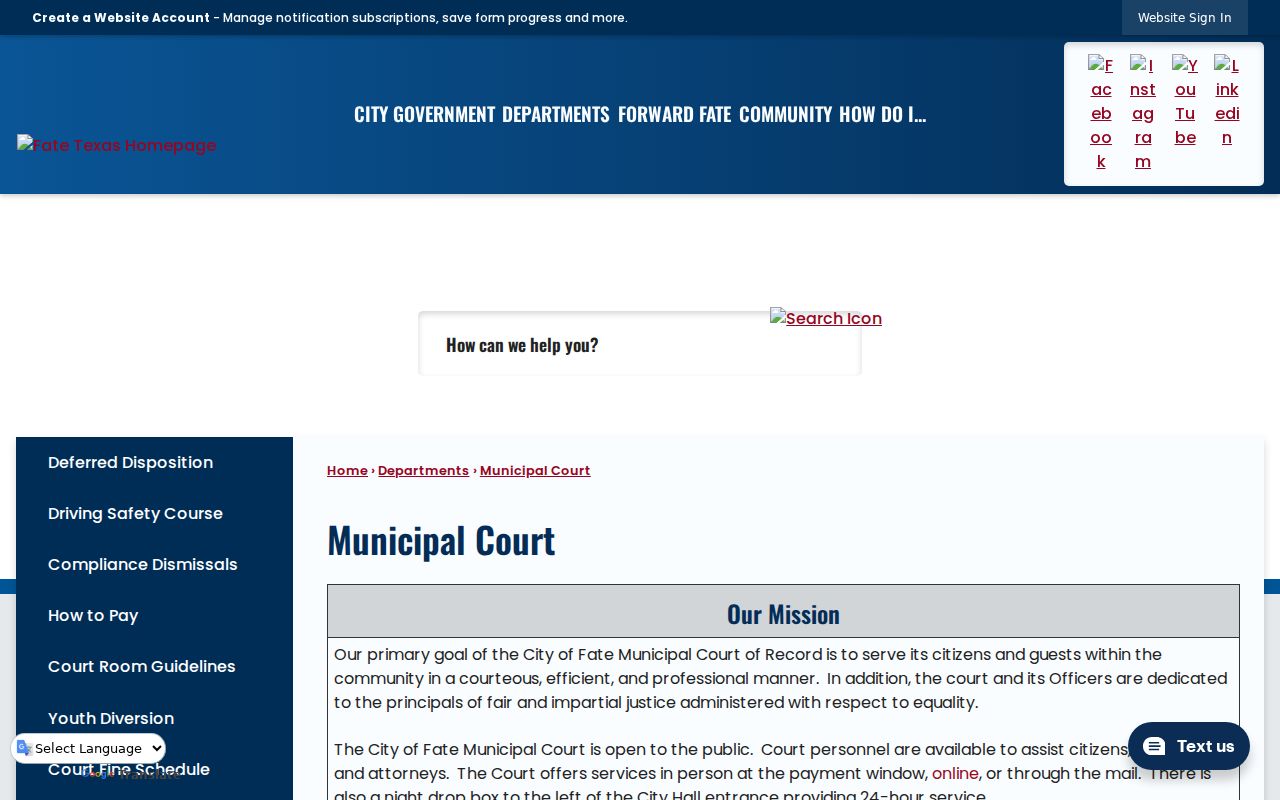
The image identifies the official city court starting point, while the separate judicial request form supplies the fields and delivery rules.
| Court Name | Fate Municipal Court of Record |
|---|---|
| Case Types Heard | City ordinance and fine-only Class C matters within municipal jurisdiction |
| Case Lookup Channel | Written judicial request in person, by email, or by mail |
| What the File Shows | Citation, charge, docket events, court action, judgment, and disposition |
| Copies and Fee | Form states $0.10 per page, subject to the current court form |
Fate Court Copy Payment
The inspected Fate judicial request form states a copy charge of $0.10 per page. It lists cash, cashier’s check, or money order as payment methods. It does not list personal checks, cards, or online payment for this records request, so do not assume the court will accept an unlisted method.
The court contacts the requester when records are ready. The form warns that some delivery methods may not be available for a large response. If an email package is too large, ask which listed alternative the clerk can use and whether added copy or mailing cost applies. Current instructions on the court form should control because charges and processing practices can change.
Note: The ten-cent rate belongs to Fate judicial copies and should not be applied to police reports or Rockwall County clerk records.
How Fate Records Reach the County
A Fate incident starts with the city department’s report. If custody follows in Rockwall County, the detention center adds a booking cycle. Prosecutors then decide whether and what to file. Fine-only municipal matters remain with Fate Municipal Court, while higher charges move to the proper Rockwall County court. Reported dispositions later feed Texas DPS.
Record flow: Fate Department of Public Safety › Rockwall County Courts › Texas Department of Public Safety
The Fate flow is not instant and it is not one database. For recent activity, use the city report and current custody channels. For the formal Fate charge and outcome, use the right court. For statewide qualifying data, use DPS after understanding what the local file says.
Fate Police and Court Requests
Fate police and court requests should not be combined. The city public-safety department is the custodian of its report and investigative material. The Municipal Court of Record is the custodian of its adjudicative case file. Even when both concern the same event, one office need not possess the other office’s full record.
| Question | Start here | Record obtained |
|---|---|---|
| What did Fate officers report? | Fate DPS records channel | Incident or arrest report |
| What happened to a city citation? | Fate Municipal Court | Docket, judgment, or disposition |
| Was the person booked? | County jail for the county of occurrence | Custody and booking entry |
When a result is missing, recheck the agency, offense location, citation number, and charge level before deciding that no Fate record exists.
Fate Citation to Court Judgment
A citation begins the local record, but it is not the final outcome. The court opens or associates a municipal file, schedules the matter, records appearances and action, and enters a judgment or other disposition. The written request form lets a requester tie that path together through the citation number, case number, offense date, and defendant identifiers.
If a custodial arrest involves a higher offense, the path changes. Booking may appear at the county jail before a prosecutor files a case. The filed charge may differ from the arrest label. The county clerk then holds the formal case, while Fate retains its originating report. A Texas DPS public name result comes later only if qualifying data is reported and publicly disseminable.
This timing is why no single name search should be called a complete Fate criminal history. Each stage creates a separate official record.
Fate Record Access Rules
Fate police records and Fate court records follow different legal lanes. The Texas Public Information Act applies to city agency information unless another law makes it confidential or an exception supports withholding. Court adjudicative records are accessed through court procedures, while judicial administrative records fall under the judicial branch’s Rule 12 framework.
Juvenile information, protected victim data, confidential identifiers, expunged records, nondisclosed public history, and active investigative details may be limited. The Texas DPS public product also shows only the public conviction and deferred-adjudication slice allowed by Chapter 411, not a person’s full fingerprint-supported history.
Key Statutes:
Texas Government Code Chapter 552 governs public-information requests to city agencies and their designated channels.
Texas Rule of Judicial Administration 12 covers judicial administrative records, not ordinary adjudicative case files.
Texas Government Code Chapter 411 sets criminal-history confidentiality and public dissemination rules.
Use a public record to understand an event or review your own history. Confirm identity and the final outcome with the office that created the original Fate record.