
Rockwall County Sex Offender Checks
The Texas Department of Public Safety manages the official public registry used for a Rockwall County sex offender check. It supports name and geographic searches, including county, city, ZIP code, street address, and radius controls where applicable. The county did not document a separate public local list. Begin with DPS, then use the registration agency shown on a profile when a current compliance question needs local confirmation.
Prepare more than a name. A middle name, alias, address, physical description, photograph, and registration agency help distinguish people with similar names. Read the entire public profile. The risk level, offense, status, conviction or adjudication details, and verification information each answer a different question. Public fields can change as an address is reported or an authority completes a verification cycle.
Rockwall County Registry Radius Searches
A county filter gives a broad Rockwall County registry result set. The official DPS address search answers a more focused location question. Enter the street address, city or ZIP code, choose a radius from the live options, and compare the map view with the result list. Exact radius choices can change in the interface, so use the labels presented by DPS rather than assuming a fixed distance.
A pin is a search aid, not a substitute for the text on the profile. If the map and street display seem different, check whether the point marks a parcel, an approximate spot, or a recently updated location. Open the profile and compare the listed address, location status, registration agency, and verification details. Contact the listed authority when a current public-safety concern depends on the precise location.
Texas Public Sex Offender Registry Searches
The free Texas Public Sex Offender Registry is the primary official search route for Rockwall County. Start with the least amount of data that can produce a useful result, then refine it. A county search can catch nearby city names, while a person search works better when a legal name or alias is known. Treat a result as a lead until the profile identifiers match.
- Open the DPS registry and review its current conditions and search choices.
- Search by name, or use address, city, ZIP code, Rockwall County, and the available radius controls.
- Review the list or map and compare names, photographs, and location details without assuming the first result is a match.
- Open the profile. Read every offense, status, risk, registration-agency, and verification field before drawing a conclusion.
- Use NSOPW when the person or address may cross a state line, and contact the listed local authority about a current compliance concern.
The official DPS registry screen exposes the statewide name-search route used for Rockwall County registry checks.
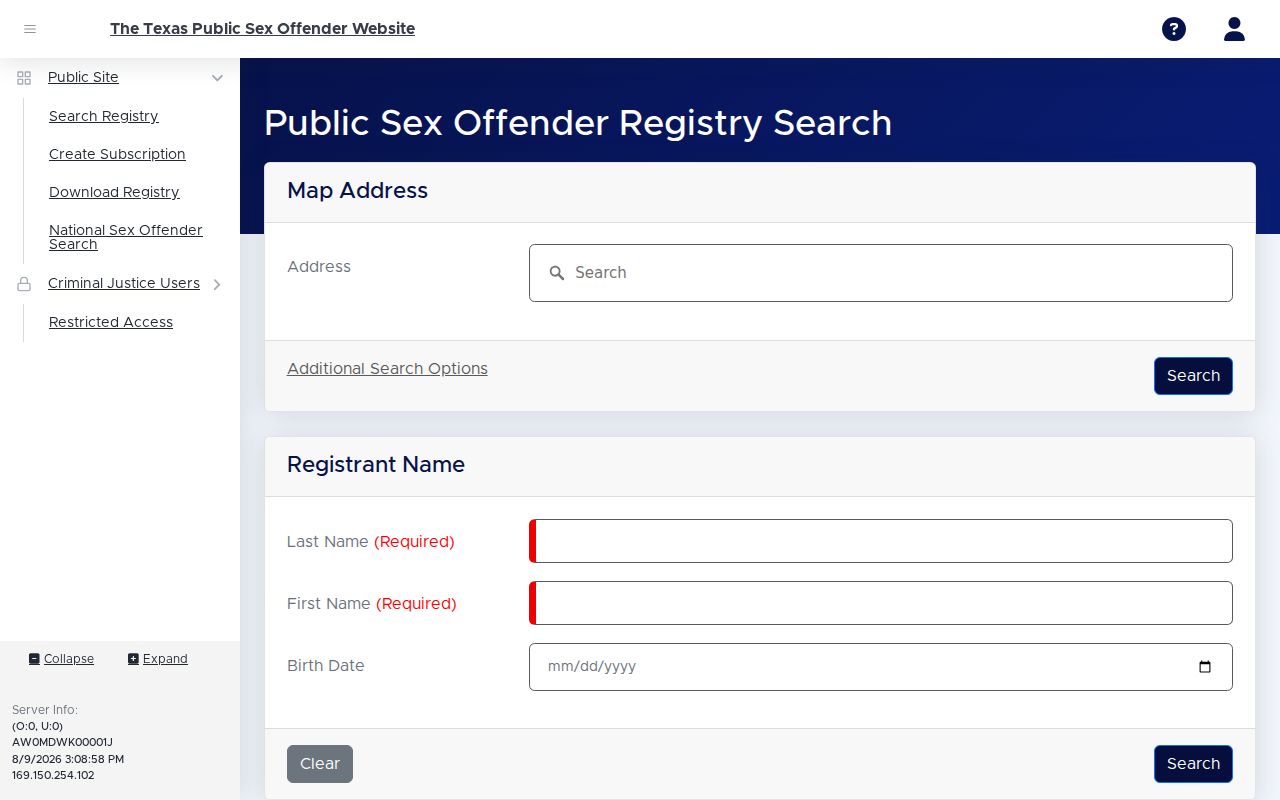
The search form is only the first layer. Open a result and match profile details before relying on the name.
| Field Label | Type | Required | Notes |
|---|---|---|---|
| Last Name | Text | Search dependent | Primary person-search field. |
| First and Middle Name | Text | Optional | Narrows a surname and helps with aliases. |
| Address | Text | Address search | Street input for geographic results. |
| City and ZIP Code | Text or select | Optional | Limits the geographic result area. |
| County | Select | Optional | Select Rockwall for countywide results. |
| Radius and Map/List | Select and view controls | Address search | Use the live radius choices and switch result views. |
| Search and Clear | Buttons | No | Run the query or remove entered criteria. |
Registry Profiles: What They Show
A public Texas profile combines identity, location, offense, risk, and registration data. Compare the current photograph and physical descriptors with the name and aliases. Next read the registered address or location status, registration agency, compliance status, risk level, and each reportable offense. Dates and jurisdictions help distinguish the conviction or adjudication from the later registration event.
| Name and Aliases | Published legal name and known alternate names used to refine identity. |
|---|---|
| Photo and Description | Current public photograph plus sex, race, age or birth information, height, weight, hair, eyes, and identifying marks when displayed. |
| Registered Location | Address or location status and the agency responsible for registration. |
| Offense Details | Reportable offense, statute, jurisdiction, and conviction or adjudication date. |
| Risk Level | Texas Level 1, 2, or 3 assessment, or a pending or unassigned status. |
| Registration Status | Compliance, verification, or absconded information shown in the current public record. |
| Other Public Fields | Victim age or sex category, scars, tattoos, vehicle, school, or occupational data when Chapter 62 permits display. |
Some public fields appear only when Chapter 62 permits them. Profiles can change after a move, verification, or agency update. Save the public profile link for reference, but return to the live record before making a safety decision.
Rockwall County Registry Status Fields
A photograph is only one identity clue. Read the verification and compliance fields with the registration agency and address. A current profile may reflect a recent check-in, a reported move, or a status that still needs local follow-up. An older image does not cancel the text record, and a familiar name does not prove identity. Compare several fields before acting on the information.
Texas registration duties include initial registration around release or disposition, in-person verification at the frequency required by Chapter 62, and timely reports of listed changes. The law uses seven-day timing for several residence and release events. The exact duty depends on the offense and status. The registry profile and the responsible authority are better sources than a broad claim about how often every person must report.
Registration Levels and Duties in Texas
Texas risk numbers describe assessed danger. They do not set registration duration by themselves. Chapter 62 ties the length of the duty mainly to the reportable offense and procedural history. Many adult sexually violent or other listed offenses require lifetime registration. Other covered adult conviction or deferred-adjudication matters generally run until the tenth anniversary after the later of release, discharge from supervision, or dismissal and discharge. Juvenile calculations are distinct.
| Texas Risk Level | General Meaning | Duration and Public Effect |
|---|---|---|
| Level 1 | Low assessed danger | Duration is offense driven, not set by Level 1 alone. |
| Level 2 | Moderate assessed danger | Duration remains offense driven under Chapter 62. |
| Level 3 | High assessed danger | Duration is offense driven; enhanced community notification may apply. |
| Pending or None | Risk is not assigned or another statutory situation applies | Read the profile and confirm the duty with the registration authority. |
Do not translate these rows into federal SORNA tiers. Texas uses its own risk assessment, and Article 62.101 controls duration through the offense and case history. The profile and statute supply the specific rule for the person shown.
Rockwall County Cross-State Registry Checks
The DPS registry is the primary source for a Texas address. The U.S. Department of Justice's National Sex Offender Public Website adds participating state, territorial, and tribal registries through one search. Use it when a person may have moved across state lines, when an address sits near a border, or when an offense was reported in another jurisdiction. NSOPW does not replace the source profile maintained by each jurisdiction.
The official NSOPW interface provides a useful second layer after a Rockwall County registry search.
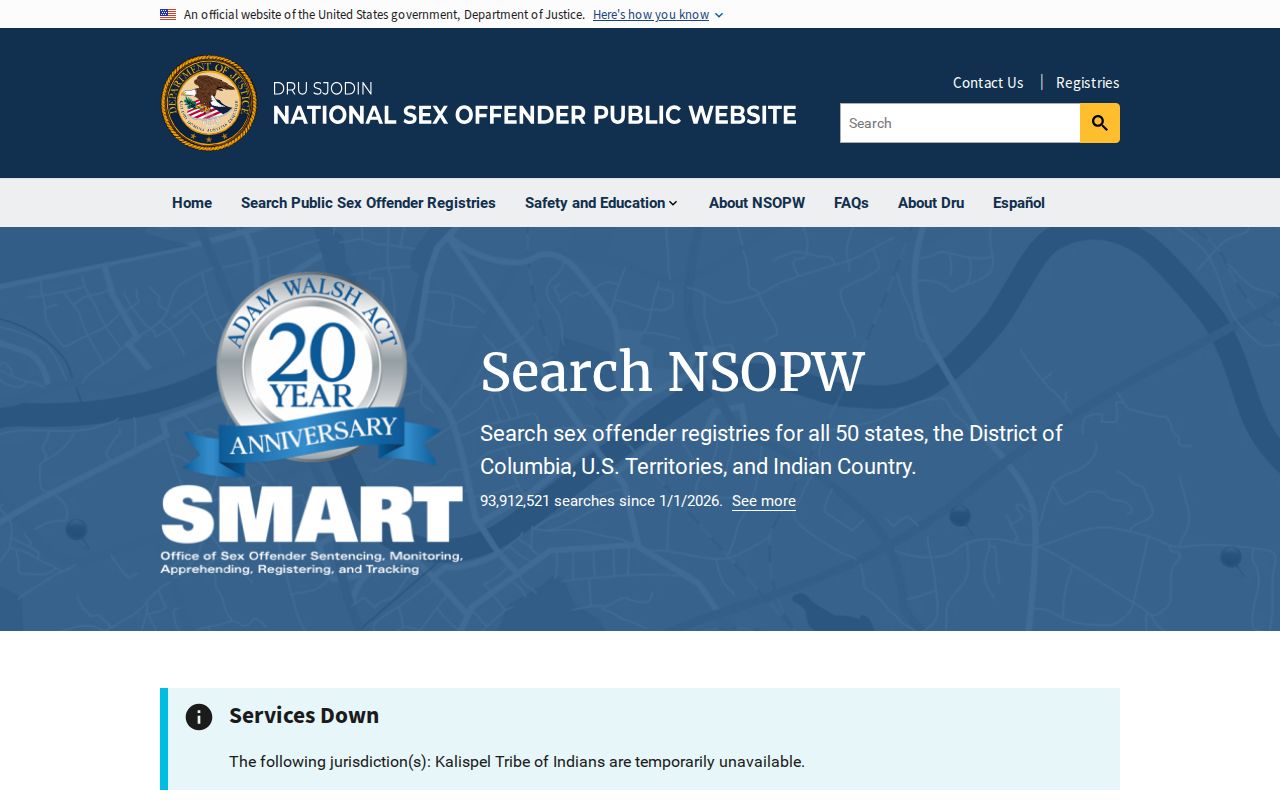
Open the linked jurisdiction record for the freshest profile and contact data. Search tools can differ in name matching, location rules, and public fields.
Rockwall County Registry No-Result Limits
No result is not a personal safety guarantee. A spelling variant, alias, address update, location outside the chosen radius, nonpublic juvenile information, reporting delay, or offense outside the registration law can change what a Rockwall County search returns. Repeat a name search with known aliases and middle names. Then switch to county and address methods rather than widening one query without a plan.
A missing result also should not trigger a confrontation. Check the search criteria, use NSOPW for other jurisdictions, and call the likely registration authority if there is a concrete compliance concern. For an immediate threat, contact law enforcement. Registry research supports awareness, but it cannot predict conduct or replace ordinary safety steps.
Using Registry Information Lawfully
The public registry serves community awareness and safety planning. Texas notification depends on risk and the facts set by law. Read the record as published and verify urgent status questions with the listed registration authority. Do not use a profile to trespass, contact a household, threaten, retaliate, or organize harassment. Suspected noncompliance belongs with Rockwall Police, another responsible city agency, or the Rockwall County Sheriff, not with a private confrontation.
Use registry data lawfully: Texas Code of Criminal Procedure Chapter 62 provides public registry information for safety. Using it to harass, threaten, trespass, retaliate, or commit another offense is unlawful and may be a crime.
Rockwall County Registry Compliance Reports
When a public profile suggests an address or status problem, record the public facts without approaching the person. Note the name, profile link, displayed registration agency, address or location status, and the exact reason for concern. Call the named municipal agency for a city address. For applicable unincorporated Rockwall County addresses, call the Sheriff at 972-204-7001 and confirm the registration route.
Be precise about what the registry actually shows. A map-pin difference is not the same as proof of noncompliance. Neither is an older photograph. The responsible agency can compare the public display with its current verification record and decide whether follow-up is needed. If there is an immediate danger or suspected crime, use emergency or direct law-enforcement channels instead of waiting on a general records request.